
Focusing on the pain points of financing, jointly exploring solutions to break the deadlock — Zhongyun Technology invited to participate in a symposium on financing challenges faced by private enterprises
Release time:2025-10-11
On October 10, 2025, the Provincial Party Committee's Reform Office convened a special symposium to explore solutions for addressing the financing challenges faced by private enterprises under the framework of joint and several liability. The meeting was chaired by relevant officials, with participation from expert scholars, as well as representatives from the Provincial Party Committee's Financial Office (Provincial Local Financial Administration), the Provincial Federation of Industry and Commerce, the Provincial Development and Reform Commission, and related divisions of the Provincial Department of Economy and Information Technology. Also in attendance were senior executives from Wuhan Zhongyun Kangchong Technology Co., Ltd. (hereafter referred to as "Zhongyun Technology"), Junteng Construction, First-Class Cabin Technology, Yiai Environmental Protection, Banbi Tian Medical, Kongyu Zhihang Technology, and Xiangda Machinery.
Ningguo Yun stated that this symposium was held at just the right time and is highly meaningful. As a representative of the business community, he expressed his honor—and also a deep sense of responsibility—for being able to voice the concerns of private enterprises. He noted that Zhongyun Technology, a high-tech enterprise dedicated to the R&D and production of intelligent operation and maintenance systems for industrial equipment, has steadily grown in recent years into a leading player in Hubei Province's smart O&M industry, thanks to its continuous technological innovation and sound business management. The company has been recognized as a "Gazelle Enterprise" by Wuhan City for three consecutive years, successfully secured a place on the list of digital transformation service providers for SMEs in multiple cities nationwide, and earlier this year, with approval from the Provincial Department of Economy and Information Technology, was officially appointed to lead the establishment of the "Hubei Provincial Innovation Center for Intelligent Operation and Maintenance of High-end Equipment Manufacturing"—a provincial-level innovation hub. Despite achieving annual sales of nearly 100 million yuan, the company is now facing financing bottlenecks amid its rapid growth, which are hindering its ability to scale up even faster.
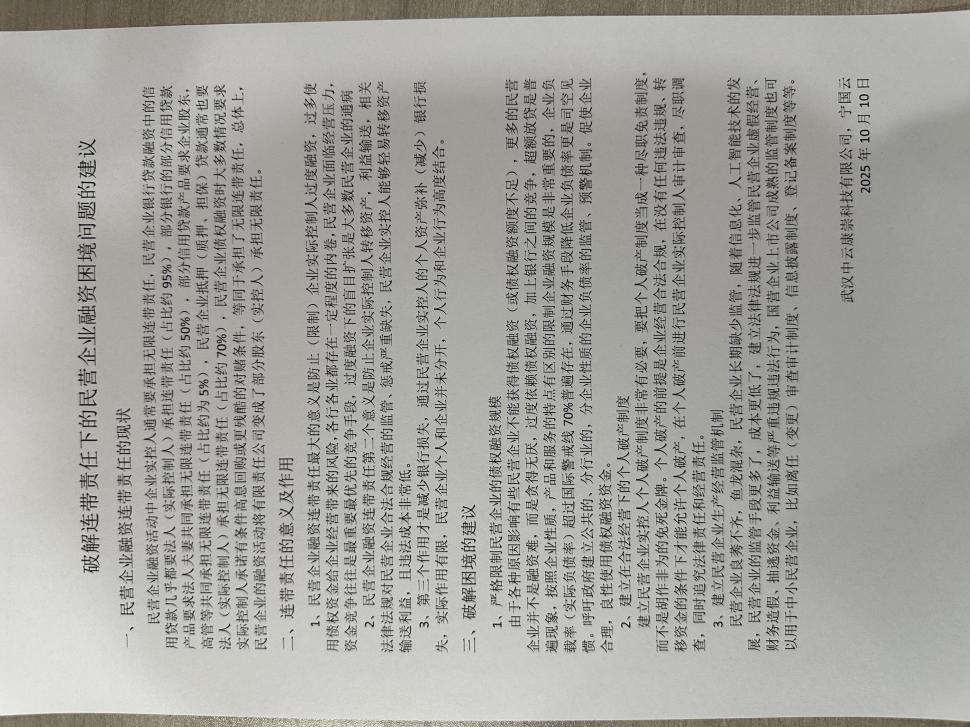
At the meeting, Ningguo Yun, drawing on his company's own financing needs, thoroughly analyzed the current pain points faced by private enterprises in securing funding. He actively offered suggestions to help overcome the financing challenges stemming from joint and several liability, while also conveying the genuine demands of private technology firms. He openly acknowledged that private enterprises—especially innovative SMEs in high-tech industries—are often constrained by financial liquidity issues as they navigate production operations, industrial expansion, and the development of sales channels. Widely facing "difficulty in finding institutions and difficulty in valuation negotiations" , the lack of efficient and professional channels for connecting investors and financing institutions has become a practical issue that limits the supportive role of equity financing in driving corporate growth. We hope relevant government departments can coordinate with specialized investment and financing consulting firms, financial institutions, and other entities to help bridge the gap between businesses and investors. This would enable companies and institutions to engage in face-to-face communication, boosting operational efficiency while simultaneously reducing corporate financing costs.
Ningguo Yun focuses on addressing the financing challenges faced by private enterprises under joint and several liability, Propose specific recommendations from three dimensions: debt financing management, risk buffer mechanisms, and operational oversight systems. , providing practical references for optimizing the private sector financing environment:
1. Strictly limit the scale of debt financing for private enterprises
Due to various factors, some private enterprises are unable to secure debt financing (or face insufficient debt financing limits). However, many private companies don’t necessarily struggle with access to capital—they simply become overly greedy and excessively reliant on debt financing. Coupled with intense competition among banks, over-lending has become a widespread phenomenon. Given the distinct characteristics of different types of businesses, their products, and services, it is crucial to impose differentiated restrictions on the scale of corporate financing. Meanwhile, corporate leverage ratios—specifically, actual debt levels exceeding the international warning threshold of 70%—are alarmingly common. As a result, reducing corporate debt through financial maneuvers has become an all-too-familiar practice. We urge the government to establish a robust, publicly accessible regulatory and early-warning system for corporate debt levels, tailored by industry and enterprise type. This initiative should encourage businesses to utilize debt financing resources in a rational and sustainable manner, fostering healthier growth and financial stability.
2. A Personal Bankruptcy System Built on Legitimate Business Operations
Establishing a personal bankruptcy system for actual controllers of private enterprises is highly necessary. This system should be viewed as an accountability mechanism that protects individuals from personal liability when they have fulfilled their due diligence, rather than as a "get-out-of-jail-free card" for reckless behavior. Before allowing personal bankruptcy, it is crucial that the enterprise has operated legally and in compliance with regulations—and only under conditions where no illegal or non-compliant activities, such as unauthorized fund transfers, have occurred. Prior to initiating personal bankruptcy proceedings, thorough audits and due diligence must be conducted on the actual controller of the private enterprise, while also ensuring that both legal and business-related responsibilities are rigorously addressed.
3. Establish a Supervision and Management Mechanism for Private Enterprises' Production and Operations
Private enterprises vary widely in quality, with both high-quality and substandard companies mixed together. For a long time, private firms have lacked adequate oversight. However, with the advancement of information technology and artificial intelligence, new tools have emerged to enhance regulatory efforts—tools that are not only more effective but also cost-efficient. These advancements provide an opportunity to establish robust legal frameworks aimed at curbing serious violations such as fraudulent business practices, financial misconduct, capital flight, and illicit transfer of profits. Meanwhile, the well-established regulatory systems already in place for state-owned and publicly listed companies can be adapted and applied to smaller private enterprises as well. For instance, measures like post-appointment (or change) review and audit mechanisms, mandatory information disclosure protocols, and comprehensive registration and filing procedures can serve as valuable models for fostering transparency and accountability across the private sector.
In fact, Zhongyun Technology itself has been actively exploring breakthroughs in the equity financing arena: In 2024, the company secured a total of 5 million yuan in investment from individual investors. Then, in the second half of 2025, after launching its Series A funding round, the company participated in Wuhan City’s “One Month, One Industry Chain” financing roadshow, holding discussions with approximately 10 investment institutions. That same morning, Zhongyun Technology also signed an investment agreement with Gaobo Capital, which plans to invest 2.4 million yuan.

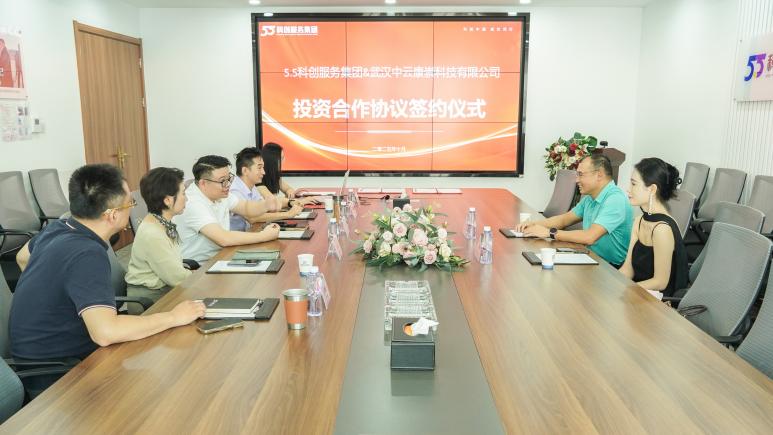

“As the leading organization of the provincial innovation center, we not only need to focus on our own development but also have a greater responsibility to speak up for the industry,” said Ningguo Yun. Looking ahead, Zhongyun Technology will continue to deepen its expertise in the field of intelligent operation and maintenance for industrial equipment, driving high-quality growth through technological innovation. At the same time, the company will closely monitor the ongoing efforts to optimize the financing environment for private enterprises, actively participate in policy discussions, and leverage its practical experience to help address the financing challenges faced by private tech firms while fostering collaborative development across the industry.
Related news
Make industry smarter and equipment healthier

Service Hotline
+86 19972156250
Wuhan Intelligent Cloud Control Technology Co., Ltd.
International dedicated line:+86 19972156250
Company Address: No. 6 Fozuling 3rd Road, Donghu New Technology Development Zone, Wuhan, Hubei, China
