
Intelligent Operations and Maintenance Platform
Embracing the Industry 4.0 Era: IEPlat Tengyun – the Intelligent Operations & Maintenance Platform, empowering comprehensive lifecycle management of equipment. By integrating cutting-edge sensing technologies, advanced data analytics, and AI algorithms, the platform enables real-time monitoring of equipment conditions, predictive maintenance, and intelligent upkeep—maximizing equipment availability, reducing maintenance costs, and ultimately unlocking greater value for businesses. Leveraging equipment operational data, it accurately forecasts potential failures and proactively intervenes before issues arise, helping companies avoid unplanned downtime and minimize production losses.
Contact:
Design characteristics
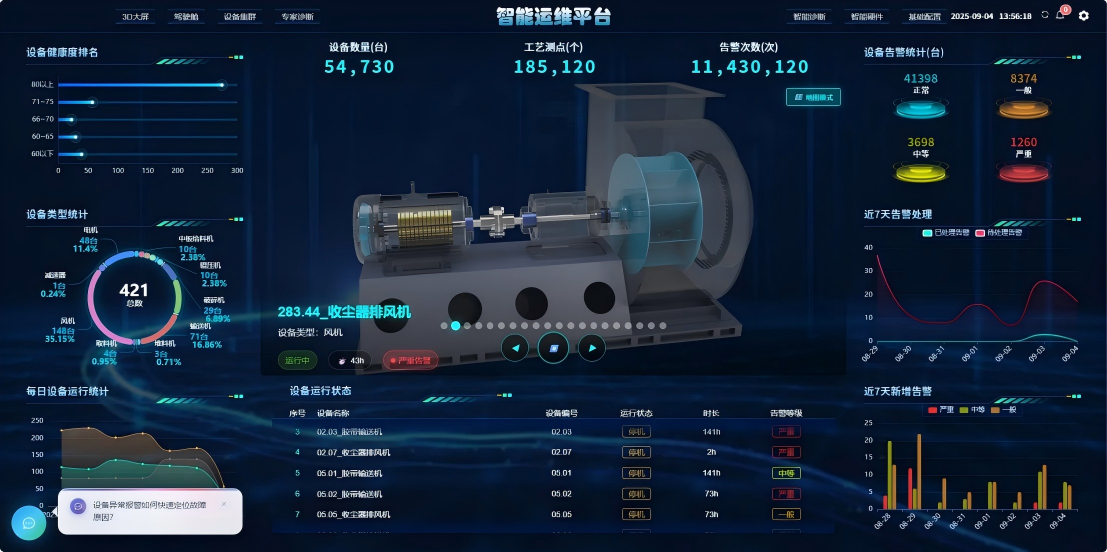
The IE-Plat Tengyun Intelligent Operations and Maintenance Platform innovatively integrates advanced PHM predictive maintenance technology with a comprehensive equipment lifecycle management system, breaking down data silos and business fragmentation that have long plagued traditional equipment management. This creates an intelligent management ecosystem covering the entire lifecycle of equipment—from "selection and procurement" to "installation, operation, maintenance, and eventual retirement." Not only does it enable real-time monitoring of equipment conditions, predict potential failures, and deliver smart maintenance solutions, but it also provides round-the-clock "health check-ups" and "failure prediction" services for your assets. Moreover, it serves as a decision-making system that continuously optimizes asset value throughout the equipment’s entire lifespan.
1. End-to-End Data Integration Across the Entire Lifecycle
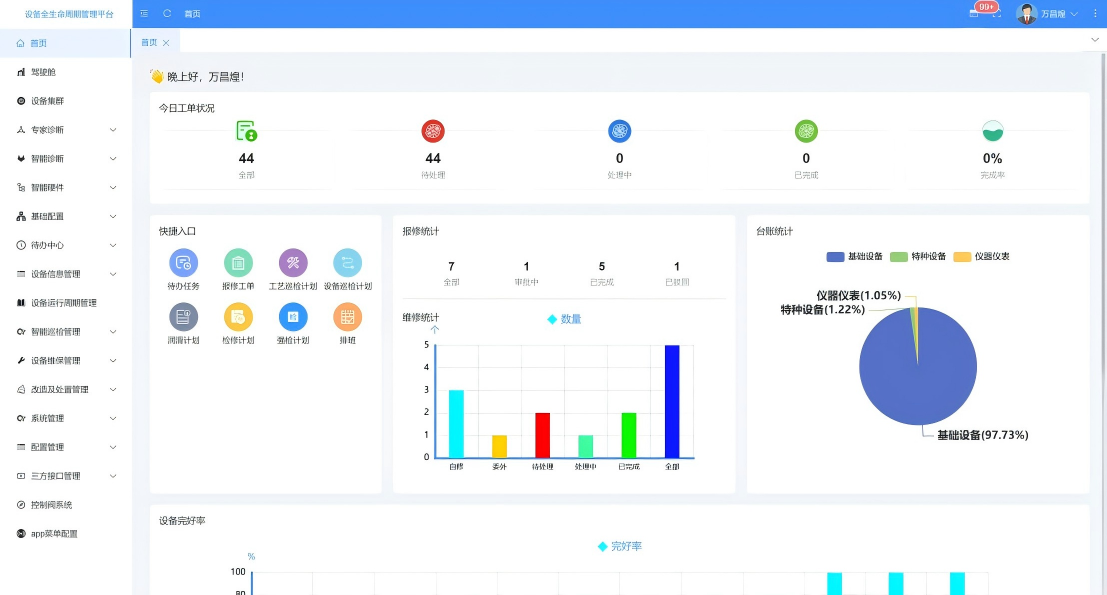
The platform establishes a unique "digital DNA" profile for each piece of equipment. From procurement contracts and installation records to operational parameters, maintenance history, and even health-status alerts, all data is seamlessly integrated. The PHM system continuously captures real-time operational status, performance degradation trends, and predictive fault data—information that is then fed back to empower decision-making at every stage of the equipment’s lifecycle: from initial selection during the early phase, to optimizing maintenance strategies in the mid-phase, and even to evaluating timely replacement or retirement in the later stages. This approach enables end-to-end, closed-loop management driven by data throughout the entire lifecycle.
2. Full-Process Business Collaboration Optimization
Fault diagnosis warnings and results are no longer isolated pieces of information—they have become critical commands that automatically trigger relevant business processes within the system. Based on predicted failure times, component status, and remaining useful life (RUL), the system can autonomously generate optimal maintenance work orders, precisely initiate spare parts procurement workflows, and optimize scheduling plans for maintenance personnel. This seamlessly transforms the "prophetic" capability of predictive maintenance into proactive actions that truly drive cost reduction and efficiency gains.
Platform Features
Supports a variety of industrial protocols and data interfaces, seamlessly integrating with existing IT/OT systems. It is compatible with multi-source heterogeneous data, enabling smooth integration of time-series data, as well as sensor data from sources such as vibration, temperature, pressure, current, and oil fluid measurements.
Visualized Panoramic Monitoring
A one-stop overview of the real-time health status of all devices, enabling quick identification of abnormal equipment. From the factory and production lines down to individual devices, drill down layer by layer while visually presenting historical data, real-time trends, spectrum analysis charts, and more. Integrated with the digital twin model, this solution delivers precise, 3D visualized localization of fault locations.
A flexible and configurable early warning system
Supports multi-level alarm threshold customization (Normal, Medium, Severe). Offers multiple alert methods (in-station messages, email, SMS, WeChat, phone calls, audio-visual alerts) to ensure critical information is promptly delivered to the responsible parties.
Powerful integration and scalability
Provides a rich set of RESTful APIs, enabling seamless integration with third-party systems such as ERP, MES, CMMS, and EAM, and automatically triggering maintenance work orders. Each functional module is decoupled, allowing for flexible combination and scalable expansion based on customer needs, while supporting public cloud, private cloud, and hybrid deployment options.
Comprehensive Value Decision Support
Deep integration has ushered in an unprecedented level of decision-making sophistication. Managers can now not only answer questions like "When will the equipment fail?" but also address more strategic, lifecycle-oriented inquiries: "Which equipment brands and models are most reliable? (Optimizing procurement)," "What’s the return on investment for our current maintenance strategies? (Optimizing strategies)," and "When is the most cost-effective time to upgrade or replace equipment? (Optimizing upgrades)." This shift enables a transformative leap—from managing individual equipment health to maximizing the overall return on investment (ROI) of your entire asset portfolio. Through this deep integration, we’re redefining equipment management: it’s no longer just a cost center, but rather a pivotal driver of value creation. Our platform ensures that every piece of equipment remains in peak condition throughout its entire lifecycle—delivering optimal performance at the lowest total cost of ownership (TCO), while unlocking maximum productivity potential.
Algorithm Engine
The algorithm engine is the platform's "intelligent brain," transforming cutting-edge algorithms into simple, user-friendly system functionalities. This allows you to effortlessly harness expert-level equipment prediction and health management capabilities—without needing to delve into complex models yourself. At the core of its predictive diagnostics, graph analysis, and intelligent decision-making are powerful, integrated smart algorithms that deliver seamless, end-to-end solutions. Moreover, this engine serves as a highly modular, fully functional, and standardized algorithmic service center, providing "ready-to-use" professional analytical capabilities for advanced applications above it.
Signal Preprocessing and Feature Extraction Center
It provides a rich library of standardized functions that automatically perform pre-processing tasks such as data cleaning, noise reduction, filtering, and normalization on multi-source, heterogeneous raw data (e.g., vibration, current, temperature, acoustics, etc.). Built-in algorithms enable the automatic extraction of dozens of time-domain, frequency-domain, and time-frequency-domain features—including metrics like amplitude, mean, variance, kurtosis, FFT spectra, and wavelet packet energy—providing high-quality, standardized input feature vectors for subsequent diagnostic models.
Diagnostic Model and Atlas Generator
The core computing unit of the engine integrates all advanced diagnostic algorithms. This module provides all diagnostic functions, including fault identification, health assessment, trend prediction, and Remaining Useful Life (RUL) calculation, among others.
Data Management and Model Training Center
Provides a visualized model training and hyperparameter tuning system, supporting data annotation, feature selection, model training, validation, and one-click deployment. Through the closed-loop process of "Data-Diagnosis-Decision-Feedback," it automatically collects operations and maintenance feedback data, continuously optimizing model performance to enable self-learning and self-evolution of algorithms.
Real-time Scheduling and Business Orchestrator
As the "nervous system" of the engine, it handles the dynamic hot-plug loading and collaborative scheduling of all algorithmic modules. Based on a pre-defined, complex business topology, it invokes the corresponding preprocessing, feature-extraction, or diagnostic models with millisecond-level response speeds. 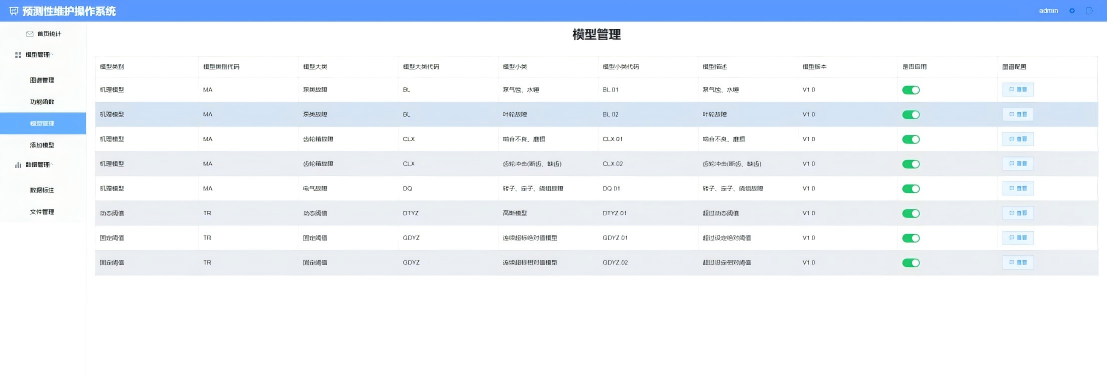
Material Download
Recommended products
Leave a message
We will contact you as soon as we receive your information and give you a surprise.

Service Hotline
+86 27-6349 9950
Contact Information
Email: administrator@hbicc.com
Address: No. 6, Fozulingle Third Road, East Lake High-tech Development Zone, Wuhan, Hubei Province